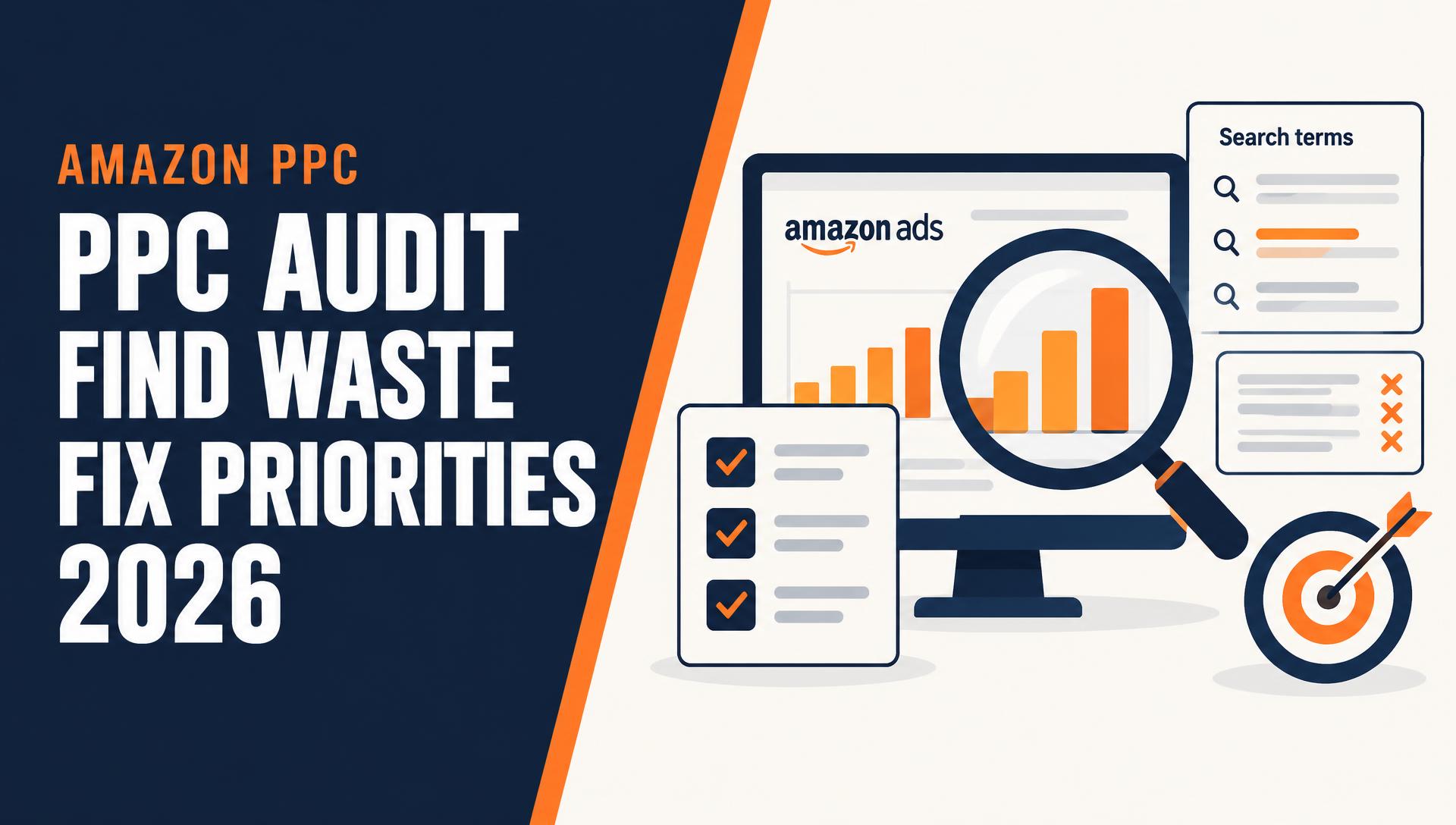
When does your Amazon PPC account need an audit?
An audit is useful when spend rises without a clear explanation, campaigns run out of budget before valuable demand is captured, or a previously reliable product stops converting. It is also useful before handing an account to a new manager: preserve the history and identify what already works before changing the structure.
A rising ACoS does not diagnose the problem by itself. Higher click costs, weaker conversion, a price change, stock constraints, or a different mix of branded and category searches can produce similar headline results. Amazon’s optimization guidance discusses targeting, bids, budgets, and product detail pages together. The first job is to isolate the cause rather than apply the same bid reduction everywhere.
This is an advertiser’s account audit, not an audit of an agency website’s Google ranking. Amazon advertising performance and the Google visibility of a service page are different measurements. Improving one does not automatically repair the other.
Start with a clean baseline and product economics
Export reporting for a representative period and a comparable earlier period. Record the marketplace, campaign type, currency, attribution settings, and dates. Avoid judging recent clicks before their reporting window has matured. Annotate changes in promotions, price, stock, and listing content so an event-driven shift is not mistaken for a management failure.
ACoS is advertising spend divided by attributed advertising sales, expressed as a percentage. TACoS uses total sales as the denominator. Neither alone establishes profitability, and a lower ratio can conceal lost sales. Review spend, attributed sales, total sales, orders, and contribution together, with branded and non-branded traffic separated where the reporting supports it.
Set a product-level advertising allowance from verified costs rather than a universal target. A contribution margin before advertising can guide a simple break-even comparison, but attribution, repeat purchases, returns, and campaign objectives affect interpretation. The following numbers are a hypothetical illustration, not Xrowlix client results or recommended targets.
| Illustrative input | Amount | Meaning |
|---|---|---|
| Net sales revenue per order | $40 | Use a consistent revenue basis |
| Product, selling, fulfillment and other variable costs | $28 | Verify actual costs and returns allowance |
| Contribution before advertising | $12 | $40 less $28 |
| Simple pre-ad contribution rate | 30% | $12 divided by $40; not a universal ACoS target |
Audit search terms before removing spend
Review actual search terms where available, not just the keywords you entered. Group them by intent: your brand, generic category demand, competitor research, and irrelevant traffic. A term with no orders may be irrelevant, or it may simply have too little mature data to judge. Those situations require different actions.
For a relevant term with weak conversion, inspect the advertised product and offer before excluding it. For clearly incompatible intent, evaluate negative targeting using the correct match type and supported campaign controls. For a promising converting term, consider a controlled targeting test while checking that the change does not unintentionally block existing discovery.
- Confirm the product actually satisfies the shopper’s query.
- Compare spend and orders with the product’s economics and the available sample.
- Review existing negatives before adding new exclusions.
- Keep a change log so a traffic loss can be traced to its cause.
Check bids, placements, and budget constraints separately
A budget problem is not the same as a bid problem. If a relevant, economically healthy campaign stops serving because of a budget constraint, reducing its bids indiscriminately may sacrifice useful demand. If a campaign has adequate budget but poor conversion, adding budget can magnify the underlying problem.
Review the bidding strategy and any applicable placement adjustments together. Compare performance by placement where reports permit, and distinguish a high sales volume from an acceptable marginal return. Make a targeted change, keep other major variables stable when practical, and review after enough mature evidence has accumulated.
| Observed signal | Investigate | Decision to test |
|---|---|---|
| Budget constrained with healthy mature performance | Availability, demand and product margin | Controlled reallocation from weaker spend |
| High spend, weak conversion | Search intent, offer and detail page | Fix relevance or conversion before scaling |
| One placement absorbs spend | Placement adjustment and sample quality | Adjust that lever rather than every campaign |
| Low impressions despite available budget | Eligibility, targeting and auction competitiveness | Resolve the constraint before assuming low demand |
Separate advertising problems from product readiness
Check availability, the Featured Offer where applicable, landed price, delivery expectations, images, and the accuracy of the detail page. A product that becomes unavailable or loses a competitive offer may need retail intervention rather than a campaign rebuild. Compare conversion around those changes instead of crediting every movement to bids.
Content fixes should answer genuine product questions: dimensions, compatibility, materials, included items, and intended use. Advertising can reveal where shoppers hesitate, but it does not justify unsupported product claims. Coordinate PPC, SEO, and creative work while keeping their outcomes separately measurable.
Turn the audit into a prioritized action plan
Do not deliver an unranked list of every possible optimization. Identify the affected campaign or ASIN, attach the evidence, state the proposed change, name an owner, and set a review window. Separate urgent eligibility problems from reversible tests and longer-term creative work.
Preserve campaigns with useful history unless there is a clear reason to replace them. Avoid simultaneously rebuilding structure, changing bids, rewriting listings, and launching discounts: you will struggle to explain which change mattered. Case studies can demonstrate agency experience, but their starting conditions and timeframes are not a forecast for your account.
| Priority | Example | Success evidence |
|---|---|---|
| Resolve first | Relevant product cannot serve or be purchased | Eligibility or availability restored |
| Control waste | Clearly incompatible search intent | Irrelevant traffic reduced without blocking useful demand |
| Test next | Economically healthy campaign is constrained | Incremental orders and contribution assessed |
| Develop | Missing product answers weaken conversion | Verified content published and comparable performance reviewed |
Use the audit before increasing Black Friday spend
The evergreen audit establishes which products and campaigns deserve additional investment. A holiday operating plan then determines how to pace that investment through changing demand. Keep those decisions distinct: a budget multiplier cannot compensate for irrelevant targeting or an unavailable product.