Check marketplace readiness before importing campaigns
Amazon’s international advertising guide states that products must be available for sale in the selected target countries. Check the live child ASIN and your offer in each marketplace, rather than assuming a product in your US catalog is ready everywhere. Confirm price, stock, delivery information and the accuracy of the detail page before paying for traffic.
Use a readiness sheet with evidence, an owner and a next action. Resolve missing or misleading product information before testing ads. Tax, import, product-compliance and fulfillment obligations need their own review; this article does not establish legal or tax eligibility.
| Check | Evidence to record | Decision |
|---|---|---|
| Offer availability | Live local product URL, selected ASIN and offer | Do not advertise an unavailable product |
| Product information | Local title, dimensions, compatibility and instructions | Correct inaccuracies before launch |
| Unit economics | Local price, fulfillment costs, fees and return allowance | Set a market-specific spending ceiling |
| Operational coverage | Owner for stock, listing and campaign issues | Assign responsibility before increasing spend |
Research local keywords, even when all three markets use English
A common language does not make search behavior identical. Shoppers may use different spellings, product names, measurements or use-case phrases. Treat imported keywords as candidates. Review local search-term reports when available, relevant listings and the actual product specifications to decide whether a query fits the offer.
For example, a hypothetical storage product could require research around both “organizer” and “organiser.” This is an illustration of a research task, not evidence that either word has more searches in a particular country. Do not add a phrase simply because it sounds local; verify relevance and performance in that marketplace.
Amazon describes keyword localization and translations within its international tools. These can reduce setup work, but a translated keyword is not proof of demand or a reason to leave inaccurate listing content unchanged. Have a knowledgeable reviewer check language and product meaning, especially when expanding beyond English.
Set local budgets from the product’s economics
Start with contribution before advertising: revenue on a consistent tax basis minus the relevant product, marketplace, fulfillment and promotional costs. Decide how much of that contribution you can risk during a controlled test. A fixed percentage copied from another country may ignore different fees, prices and return costs.
Set country-level review triggers for availability problems, irrelevant traffic and spending that exceeds the agreed test allowance. An early low order count may reflect limited data rather than a failed market. Choose a review window that matches the account’s attribution and reporting delays, then document why you continue, change or pause.
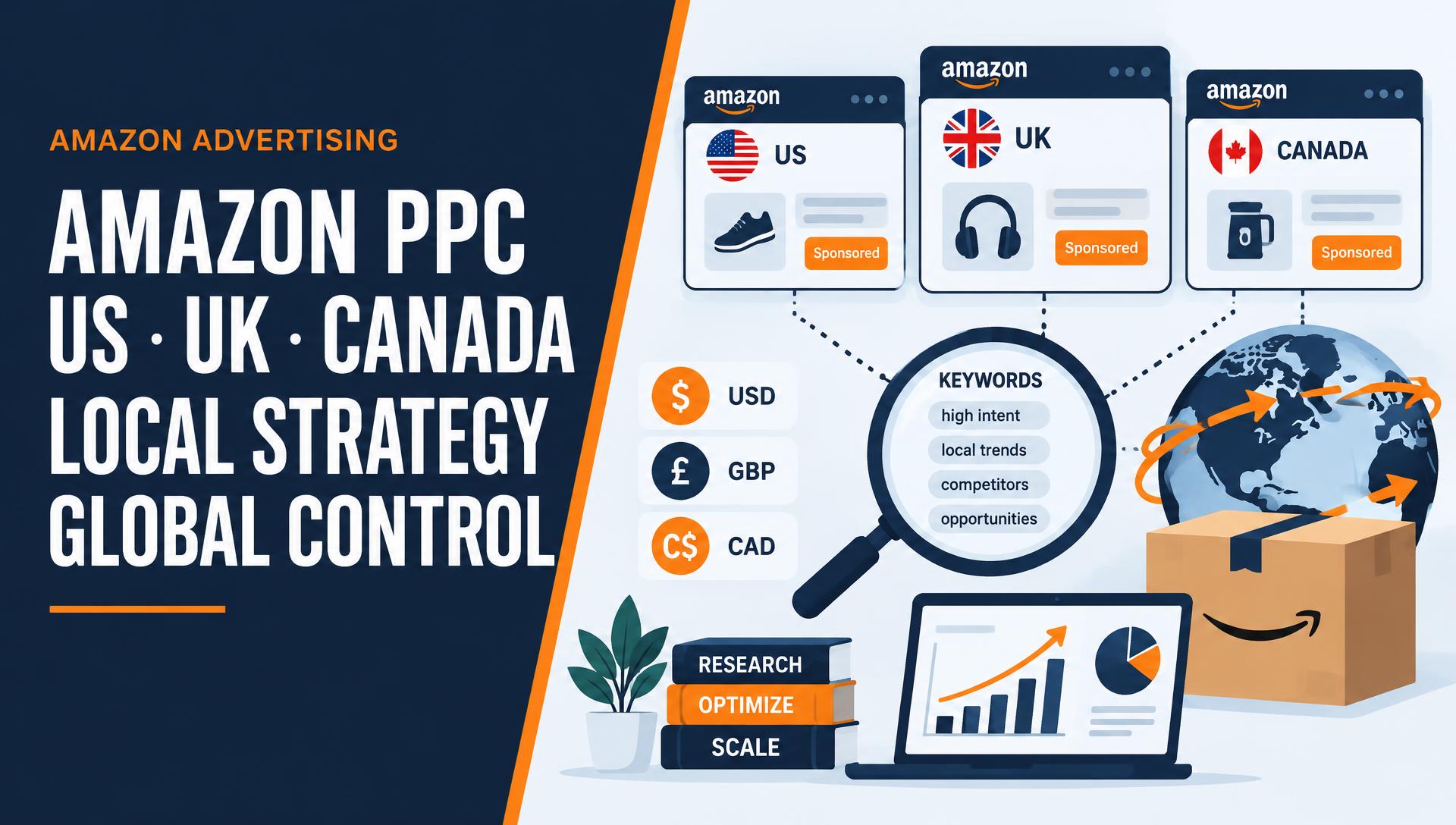
Amazon’s guide describes local flexibility within global Sponsored Products campaigns. Use the controls available in your account; do not assume every interface or advertising product exposes the same options. Consolidated management should simplify oversight, not hide local underperformance.
Compare reports without mixing currencies or definitions
Raw spend and sales in USD, GBP and CAD cannot be added together as though they were one currency. Keep local totals and, if you need a consolidated view, label the reporting currency, exchange-rate basis and period. Amazon states that display currency conversion does not change actual invoices or payments.
ACoS is advertising spend divided by advertising-attributed sales; ROAS reverses that ratio. They can help compare efficiency only when report definitions, date ranges and attribution scope are consistent. Neither measure is net profit, and neither proves the campaign caused every attributed purchase.
A country with a better ACoS can still produce less contribution after costs. Review efficiency beside stock availability, conversion, attributed sales and the local margin model. Keep new-market learning separate from established campaigns and annotate price changes or promotional periods.
| Field | Local review | Consolidated review |
|---|---|---|
| Spend and sales | Original marketplace currency | Declared currency and conversion basis |
| Efficiency | Matching attribution and date scope | Same definitions across countries |
| Profitability | Local costs and contribution | Comparable cost treatment |
| Context | Stock, price, product and promotion changes | Country notes remain visible |
What to ask an international Amazon advertising agency for
Ask for a market-by-market plan rather than a claim that one global strategy fits every store. A useful handover contains local offer checks, a keyword rationale, budget controls, reporting definitions and named responsibility for operational issues. Ask which decisions the agency can make independently and which require your approval.
Your business should retain appropriate account ownership and access controls. Request a sample report showing how country performance is separated and how changes are documented. A polished total-sales chart without currency or attribution context is not enough to judge the work.
- A country-level readiness sheet with evidence and owners.
- A keyword map separating tested terms from imported hypotheses.
- Local spending limits and documented review triggers.
- Reports with currencies, periods and attribution definitions.
- A clear escalation path for stock, price and listing issues.
A repeatable country-by-country review
At each agreed review, start with availability and product-information changes. Next inspect traffic relevance and attributed orders, then compare spending with the local test allowance. Decide on one material change at a time when practical, record the reason, and give the revised setup an appropriate observation period.
When a market performs well, confirm the result is not just a currency display change, a temporary discount or a stock advantage. Scale only where the economics and operations support it. During Black Friday, label the event period separately so short-term promotional performance does not become the assumed normal baseline.