What do Amazon PPC services actually include?
Before comparing providers, define the work you need done. Amazon PPC management is an ongoing operating process, not simply launching campaigns and checking whether sales increased. The scope should connect targeting and spending decisions with product eligibility, listing conversion, stock availability, and your commercial goals.
The right review cadence depends on spend, traffic, promotions, and how quickly the account changes. A weekly reporting rhythm is useful, but it does not mean every bid should change every week. Low-volume campaigns need enough evidence before decisions, and reports should account for attribution delays.
- Campaign audit and structure: separate objectives, products, and targeting logically; rebuild only where the diagnosis supports it.
- Keyword and product targeting research: identify relevant search terms, ASINs, and categories for the campaign types in scope.
- Bid, budget, and placement optimization: allocate spend against margin, performance, and inventory constraints.
- Search-term analysis and negative targeting: reduce irrelevant traffic without cutting useful discovery prematurely.
- Sponsored Brands creative testing where eligible: agree whether design, video production, and revisions are included.
- Reporting and planning: monitor attributed sales, ACoS, TACoS, conversion, and business-level profitability together.
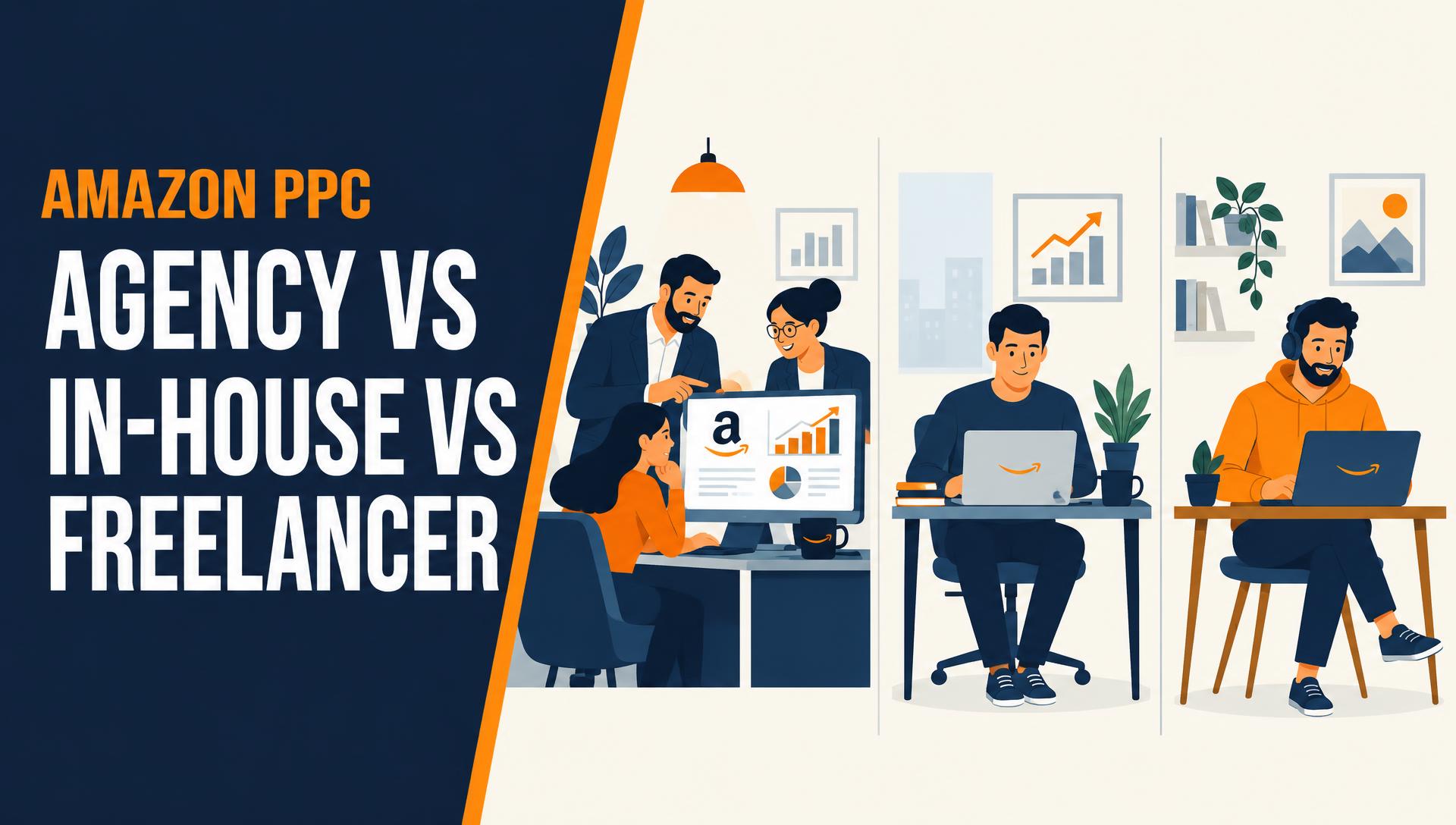
Option 1: Build an in-house Amazon PPC team
An internal PPC manager works close to your product, finance, and inventory teams. That proximity can be valuable when advertising decisions depend on frequent launches, supply changes, or strict approval processes. You retain direct responsibility for priorities and execution.
The trade-off is the total cost of ownership. Salary is only one part: recruitment, benefits, software, training, management time, and holiday cover also matter. A single specialist may be excellent at advertising but still need support with listing copy, creative, analytics, or account operations.
In-house is a strong fit when you have enough sustained workload to justify the role and someone qualified to manage it. Document campaign rationale and maintain company-owned access so account knowledge survives a staffing change.
| Advantages | Trade-offs |
|---|---|
| Close product and brand knowledge | Recruitment and onboarding can take time |
| Direct communication and prioritization | Specialist support may still be needed |
| Internal ownership of processes | Tools, management, and backup add costs |
Option 2: Hire an Amazon PPC freelancer
A freelancer can be a sensible choice for a small catalog, a stable account, or a tightly defined advertising assignment. You may work directly with an experienced operator without paying for a broader service package you do not need.
Freelancers are not automatically cheaper or less capable than agencies. Senior specialists may charge premium fees, and some provide creative or analytical support through collaborators. Compare the person's actual skills, workload, and agreed deliverables rather than assuming the label tells you the quality.
The main risk is concentration. If one person owns strategy, execution, and reporting, ask what happens during absence or when your portfolio expands. Keep research, reporting, and campaign documentation in accounts and folders your business controls.
- Best fit: a clear scope, manageable workload, and an internal owner who can coordinate other needs.
- Ask about capacity: how many accounts do they manage, and who covers urgent issues?
- Clarify exclusions: listing updates, creative production, and account health are not automatically part of PPC management.
Option 3: Work with an Amazon PPC agency
A specialist Amazon ads agency can provide a strategist, campaign operators, reporting support, and creative resources under one engagement. That can be useful when your account needs several capabilities at once or when you lack the time to coordinate multiple specialists.
However, agency scope varies. Some firms only manage campaigns; others also handle listings, SEO, creative, and operations. A full-service label does not prove those disciplines are included in your fee or assigned to your account.
Ask to meet the day-to-day lead before signing. Senior oversight, documented reviews, and a clear escalation path matter more than insisting every task must be handled by a senior employee. An agency may onboard quickly, but meaningful results still depend on retail readiness, competition, and the quality of its work.
In-house vs freelancer vs agency: quick comparison
Use this as a starting point, not a fixed ranking. A strong freelancer can outperform a weak agency, and an agency can work effectively alongside an internal ecommerce lead.
| Factor | In-house | Freelancer | Agency |
|---|---|---|---|
| Cost structure | Salary, benefits, tools, recruitment | Project or ongoing specialist fee | Retainer, spend-based, or hybrid fee |
| Direct control | High, with internal management | Defined by scope and communication | Shared through approvals and governance |
| Coverage | Depends on hired roles | Depends on individual or collaborators | Depends on contracted team and services |
| Setup speed | Depends on hiring and experience | Depends on availability and access | Depends on onboarding and account readiness |
| Continuity | Requires internal backup | Requires an absence and handover plan | Confirm assigned backup and documentation |
| Best fit | Sustained workload and internal leadership | Focused scope with manageable complexity | Multi-specialist work or coordination needs |
Which option is right for your brand's stage?
Revenue alone is a poor hiring threshold. Two brands with the same sales may have very different margins, ASIN counts, marketplaces, and advertising workloads. A simple account with high revenue may need less support than a smaller business with many launches and complex variations.
New sellers should prioritize product eligibility, listing readiness, and a controlled learning budget. A freelancer or limited agency engagement may be sufficient. Growing catalogs often need coordinated advertising, creative, and operations; an agency or hybrid model can reduce coordination gaps. Mature brands may prefer an internal lead supported by external specialists.
Wholesale sellers and resellers should also confirm advertising eligibility and monitor the Featured Offer, often called the Buy Box. Competitive offers, stock, and contribution margin can limit the value of more traffic. No provider can guarantee winning the Featured Offer.
How do Amazon PPC agencies charge?
Common arrangements include a fixed monthly retainer, a percentage of advertising spend, or a hybrid with a base fee and a variable component. Performance-based terms need a precise definition of the metric, attribution window, baseline, and exclusions. These are general pricing models, not a published Xrowlix price list.
Compare total costs for the same scope. Advertising spend is separate from management fees, and software, creative production, setup work, or extra marketplaces may also be billed separately. A low headline fee can be misleading if necessary work is excluded.
A spend-based fee is not inherently wrong, but agree safeguards against increasing budget without protecting margin. A performance bonus can also create distorted incentives if it rewards attributed revenue while ignoring returns, discounts, organic sales, or contribution profit.
- Request a written scope, fee calculation, minimum fee, and any spend tiers.
- Confirm setup charges, software fees, creative allowances, and marketplace coverage.
- Define approval rights for budget changes and how performance incentives are calculated.
- Check notice periods, handover obligations, and ownership of accounts and assets.
7 questions to ask before hiring an Amazon ads agency
Ask for examples rather than a simple yes. A sample report, documented workflow, and conversation with the assigned lead provide better evidence than a polished sales pitch.
- 1. Who manages the account day to day, what is their relevant experience, and who provides oversight and backup?
- 2. Can you show comparable case studies with a clear time period, starting point, spend, and measurement method?
- 3. How will you set target ACoS and TACoS using our margin, fees, returns, and growth objectives?
- 4. What does reporting show, and how will you explain actions, attribution delays, risks, and next steps?
- 5. What is included beyond campaigns—listing work, SEO, creative, and account support—and what costs extra?
- 6. How do you handle policy issues, disapproved ads, access permissions, and escalation without promising outcomes you cannot control?
- 7. What are the contract, budget approval, termination, and handover terms, and do we retain all account access and assets?
Red flags when choosing an Amazon marketing agency
A new specialist may not yet have a large public case-study library. That is not proof of poor work, but you should seek alternative evidence such as references, a sample audit, and transparent working processes.
- Guaranteed rankings, sales, or a specific ACoS within a fixed number of weeks.
- Case studies without dates, context, or a distinction between total revenue and ad-attributed sales.
- Reports limited to clicks and impressions, without commercial interpretation.
- Pressure to spend more without discussing margin, conversion, or inventory.
- Unclear account ownership, excessive permissions, or no documented handover.
- Unexplained lock-in terms or a different delivery team from the one presented during sales.
What results should you expect from Amazon PPC management?
Start with a baseline and a diagnosis, not a promised outcome. Early work may improve structure, remove irrelevant targeting, or reveal listing and stock problems. Sales and efficiency changes depend on demand, competition, pricing, reviews, availability, and your starting position. Results from another brand are examples, not forecasts for yours.
ACoS is advertising spend divided by ad-attributed sales, multiplied by 100. TACoS is advertising spend divided by total Amazon sales for the same reporting scope and period, multiplied by 100. Neither metric alone proves profit. Break-even ACoS should reflect contribution margin before advertising, including relevant product costs, Amazon fees, fulfillment, discounts, and returns.
New-to-brand reporting is not available in the same way for every campaign type. Where it is available, check the metric's definition and lookback period; do not treat a new-to-brand percentage as a measure of all shoppers in the account. Compare like-for-like periods and distinguish total sales from advertising-attributed sales.
Review case studies for their business context and measurement period. A useful partner explains which changes were made and what other factors could have influenced the outcome, rather than attributing every improvement to PPC alone.
| Published Xrowlix example | Reported outcome | Context to check |
|---|---|---|
| DTC Sports & Outdoors | $438,474 revenue and 92% new-to-brand revenue share over 12 months | The 16.71% ACoS figure covers a separate 14-month advertising period; these are not one identical reporting window. |
| Home & Kitchen cookware | Revenue rose from $612,400 to $1,423,800; ACoS moved from 41% to 18% over 12 months | The engagement included broader marketplace and retention work, not PPC alone. |
| Beauty & Personal Care | Approximately $2.8M revenue and 44,498 new-to-brand customers reported for 2025 | Read the detailed full-funnel case for the measurement scope; customer counts are not the same as revenue share. |
Next steps: choose the work before choosing the provider
Write down your catalog size, marketplaces, monthly advertising budget, margin constraints, launch calendar, and internal capabilities. Give each shortlisted provider the same brief and compare their diagnosis, scope, reporting, and total cost. The right answer may be an agency, an internal hire, a freelancer, or a combination.
If listing relevance and conversion are holding advertising back, coordinate PPC with SEO and creative rather than increasing bids in isolation. If stock and account operations are the bottleneck, solve those dependencies before scaling traffic.
For an expert review of your current setup, contact Xrowlix about a free Amazon PPC audit. The discussion should identify priorities and scope; it is not a promise of a particular sales result or ACoS.