What is an Amazon Sponsored Ads agency?
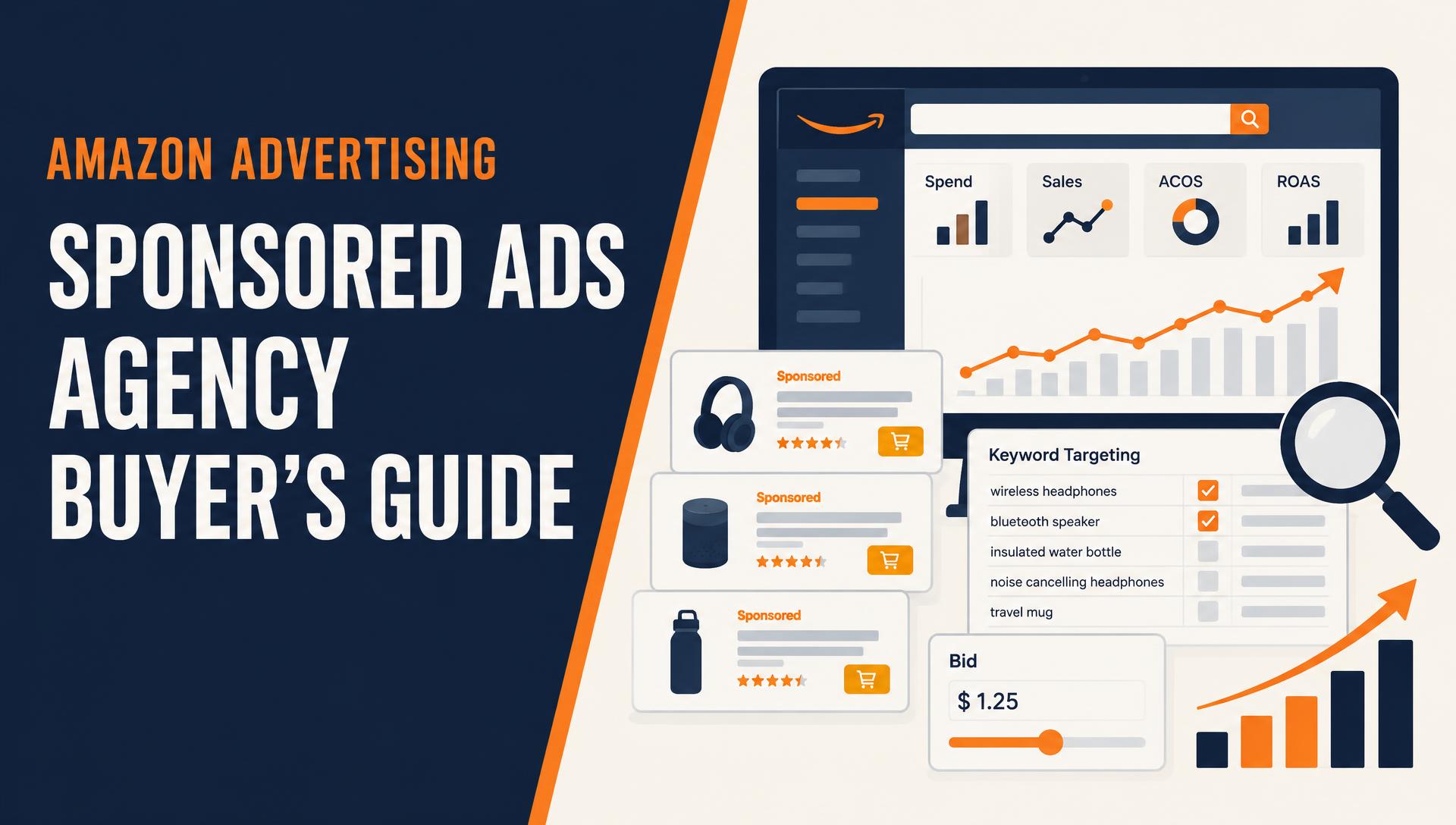
An Amazon Sponsored Ads agency is a specialist advertising partner for brands and sellers using Amazon's self-service ad formats. Its job is to turn shopper searches and product-page traffic into profitable, measurable demand while protecting the account from wasted spend.
It differs from a general PPC agency because Amazon ads depend on retail signals. Price, Prime eligibility, reviews, Buy Box ownership, inventory, category rank, and listing conversion all affect performance. Bid management without those inputs is incomplete.
The three Sponsored Ads formats an agency should manage
A good media plan assigns each format a job. Sponsored Products usually carry the conversion load. Sponsored Brands can expand category visibility and tell a clearer brand story. Sponsored Display adds product targeting and audience tactics. Copying one bid rule across all three ignores how shoppers use them.
| Format | Where it appears | Best use |
|---|---|---|
| Sponsored Products | Search results and product detail pages | Capture high-intent demand at ASIN level |
| Sponsored Brands | Search placements with brand, video, or collection creative | Build consideration and direct shoppers to products or Store pages |
| Sponsored Display | Amazon placements and eligible off-Amazon inventory | Reach contextual audiences and re-engage shoppers |
What should Sponsored Ads management include?
- Account and retail-readiness audit before campaign changes
- Campaign architecture by product, objective, match type, and funnel stage
- Keyword, category, ASIN, audience, and defensive brand targeting
- Daily budget controls and bid adjustments based on conversion and margin
- Search-term harvesting plus negative keyword and negative product targeting
- Sponsored Brands image, video, headline, and landing-page testing
- Placement and daypart analysis where the available data supports it
- Weekly risk monitoring for Buy Box loss, suppressed listings, and stockouts
- Reporting that connects ad sales to total sales, organic visibility, and profit
What a useful Amazon ads audit should find
An audit should explain where money is leaking and what prevents scale. It should not be a software export with every campaign labelled good or bad by one ACOS threshold.
| Audit area | What to inspect | Typical decision |
|---|---|---|
| Structure | Mixed ASINs, goals, match types, and branded terms | Separate control and reporting |
| Search terms | Spend without orders and converting queries trapped in auto | Negate waste and graduate winners |
| Budget | Campaigns capped early while weaker campaigns keep spending | Reallocate by marginal return |
| Placement | Top-of-search, rest-of-search, and product-page performance | Set placement modifiers selectively |
| Retail readiness | Price, reviews, images, Buy Box, inventory, conversion | Repair the detail page before forcing traffic |
| Incrementality | Branded capture versus category and competitor growth | Balance defence with acquisition |
ACOS, TACoS, ROAS, and profit: which metric matters?
No single metric is enough. ACOS divides ad spend by attributed ad sales; ROAS shows the inverse. TACoS divides ad spend by total sales and helps show whether advertising supports organic growth. None of them is the same as profit because product cost, Amazon fees, fulfilment, returns, discounts, and tax still matter.
- Use break-even ACOS as a guardrail based on real contribution margin
- Track TACoS to see whether total revenue is becoming less dependent on ads
- Separate branded, category, competitor, launch, defence, and remarketing goals
- Review new-to-brand metrics where available to distinguish acquisition from existing demand
- Judge scale by the next dollar's return, not the account's historical average
How Amazon Sponsored Ads agencies charge
Common models are a fixed monthly retainer, a percentage of ad spend, or a hybrid. A percentage can align fees with workload as accounts scale, but it can also reward higher spend. A fixed fee creates budget predictability, although the scope should adjust if the catalogue or marketplace count changes materially.
Ask whether creative, software, marketplace expansion, DSP, listing optimization, and one-time restructures are included. Sponsored Ads and Amazon DSP are different buying systems, so do not assume a PPC retainer includes DSP.
A seven-point agency selection scorecard
- Diagnosis: does the proposal identify account-specific constraints or repeat a standard pitch?
- Economics: can the team explain break-even ACOS and contribution margin?
- Control: will you retain ownership and full access to the advertising account?
- Team: do you know who makes bids, writes copy, and approves strategy?
- Testing: is there a documented method for experiments and learning?
- Reporting: are branded and non-branded results separated and tied to total sales?
- Communication: are meeting cadence, response times, and urgent escalation clear?
Red flags in an Amazon advertising agency pitch
- A guaranteed ACOS, ROAS, or sales number before account access
- Treating a lower ACOS as the goal for every product and growth stage
- No discussion of conversion rate, reviews, price, stock, or Buy Box
- Combining brand defence and new-customer acquisition in one headline result
- Automated bid changes without human review of product context
- Increasing budgets without explaining the marginal return expected
- Holding the ad account or campaign history when the relationship ends
What the first 90 days should look like
Not every account needs a complete rebuild. Preserving campaigns with useful history is often smarter than deleting everything for a cleaner dashboard. The agency should explain which structures will remain, which will change, and how it will avoid disrupting proven demand.
| Period | Priority | Expected output |
|---|---|---|
| Days 1–30 | Baseline and control | Audit, profit guardrails, tracking, quick waste removal |
| Days 31–60 | Structure and testing | Campaign rebuilds, query graduation, creative and placement tests |
| Days 61–90 | Scale and learning | Budget reallocation, winning test rollout, forecast and next-quarter plan |