1. Why Amazon PPC needs a routine, not a rebuild
Search behaviour, competitor bids, stock levels and prices change every week. An account that was well built six months ago slowly collects wasted search terms, outdated bids and budgets that run out at the wrong time. A fixed routine catches that drift early and keeps every decision tied to profit.
This checklist is for ongoing optimization. If you are taking over an account or suspect deeper problems, start with a full audit first.
2. Before you optimize: set a profit target for each product
Optimization needs a target. The simplest is break-even ACoS: your profit margin before advertising, divided by the selling price. If a product sells for $40 and leaves $12 after product cost, Amazon fees and shipping, its break-even ACoS is 30%. Above 30%, each ad sale loses money on its own.
Many brands accept a higher ACoS for launches or to win new-to-brand customers, and a lower one for mature products. Write the target down per product, and pair it with TACoS (total ad spend divided by total sales, including organic sales) so you can see whether ads are lifting the whole business.
| Metric | Formula | What it tells you |
|---|---|---|
| ACoS | Ad spend ÷ ad-attributed sales | Efficiency of the ads themselves |
| Break-even ACoS | Profit before ads ÷ selling price | The ACoS at which an ad sale stops making money |
| TACoS | Ad spend ÷ total sales | How dependent the product is on advertising over time |
| ROAS | Ad-attributed sales ÷ ad spend | The inverse of ACoS, used in many reports |
3. The weekly checklist
Give targets enough data before judging them. A keyword with eight clicks and no sale is not yet a failure if your product converts at 10%; one with 60 clicks and no sale usually is.
- Search term report: move terms with consistent orders at a good ACoS into exact-match campaigns.
- Negatives: add irrelevant terms and terms with many clicks and no orders as negative exact or negative phrase, at the right campaign or ad group level.
- Bids: raise bids on targets below target ACoS with room to grow impressions; lower bids on targets above target ACoS that have enough clicks to judge.
- Budgets: check whether any profitable campaign ran out of budget before the end of the day, and fix that before raising bids elsewhere.
- Stock and price: pause or reduce ads on products that are low in stock or whose price has changed.
- Branded defense: confirm your branded campaigns are funded and showing for your own brand searches.
4. The monthly checklist
- Product-level profit: compare each product's ACoS with its break-even ACoS and target.
- TACoS trend: if TACoS rises while total sales are flat, ads are replacing organic sales instead of adding to them.
- Placements: compare top of search, rest of search and product pages, and adjust placement bid adjustments where conversion clearly differs.
- Match types: check that broad and phrase campaigns are feeding exact campaigns, not competing with them for the same terms.
- Product targeting: review competitor ASIN targets and categories; drop those that do not convert and add the ones shoppers compare you with.
- Sponsored Brands and video: check new-to-brand share and creative fatigue; refresh creative that has run for months.
- Listing check: if conversion falls, fix the listing before increasing bids.
5. The quarterly checklist
- Re-run unit economics after fee changes. Amazon's 2027 FBA fee changes start January 15, 2027, which changes break-even ACoS for many products.
- Plan seasonal demand: build keywords and budgets ahead of events such as Prime Day, Prime Big Deal Days and Q4.
- Test one new ad type or format per quarter with a set budget and a clear success measure.
- Review account structure: merge campaigns that are too small to learn, and split ones that mix products with very different margins.
- Check new markets: if you sell in the UK or Canada, review whether US learnings apply locally.
6. Using Amazon's AI recommendations without losing control
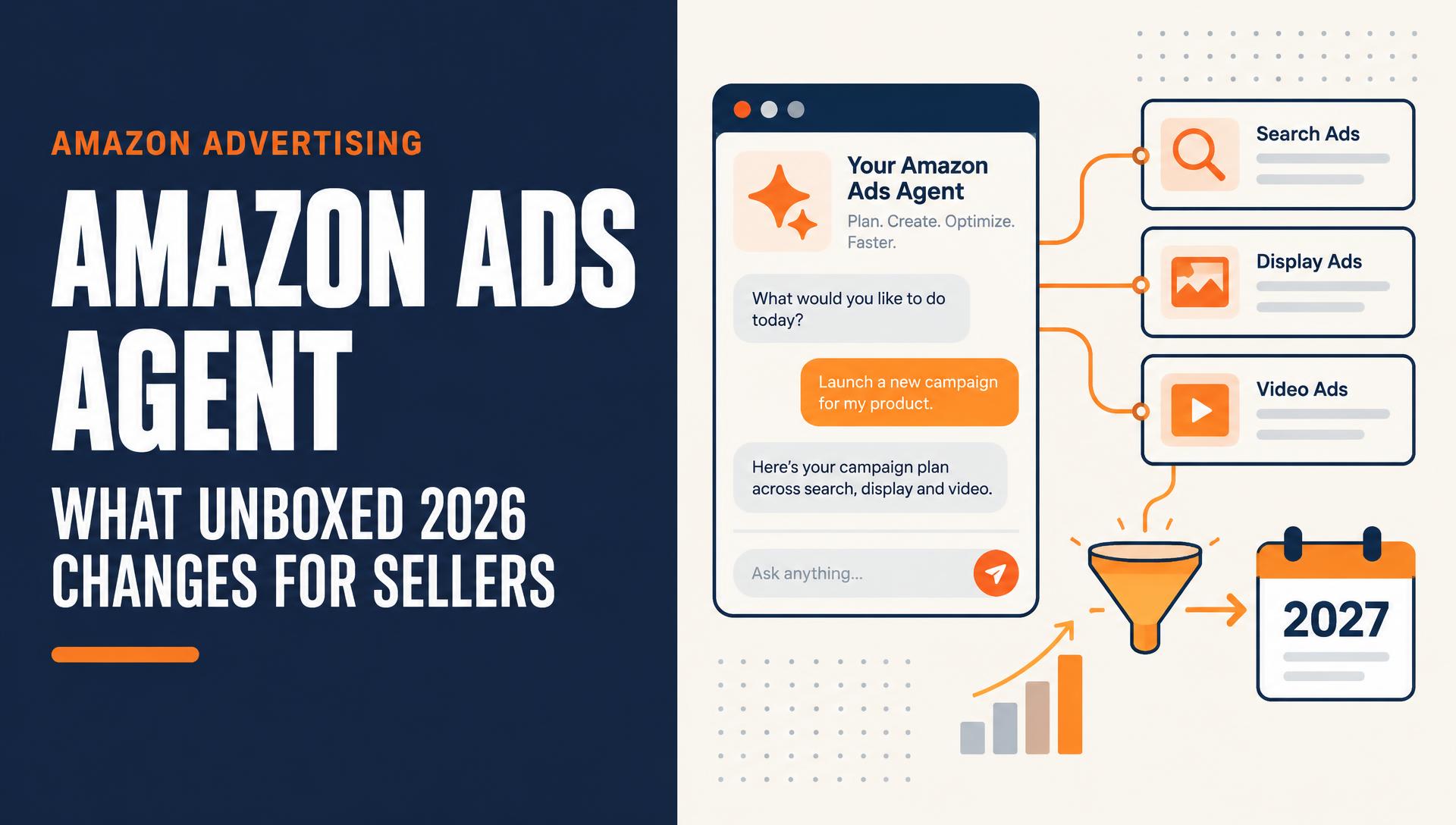
At unBoxed 2026 Amazon Ads introduced Amazon Ads Agent, a conversational experience that brings campaign planning, targeting and analytics together. Amazon says it can identify opportunities to improve Sponsored Products campaigns with recommendations for targeting, bids and budgets, applied in one click, and answer questions across nearly 1,000 metrics. Amazon reported that US advertisers applying natural-language targeting recommendations saw more than 25% more unique customers and more than 10% lower cost per impression on average; treat those as Amazon's figures.
Use recommendations as a fast first draft. Before applying them, check each one against the product's profit target, stock and price. A bid increase that makes sense for Amazon's reach goals may not make sense for a product with thin margins.
7. Common optimization mistakes
- Cutting bids on every high-ACoS target without checking whether it drives new-to-brand customers or ranking.
- Adding negatives too early, before a term has enough clicks to judge.
- Raising bids when the real problem is conversion: price, images, reviews or stock.
- Judging a week of results before attribution has caught up.
- Letting automatic campaigns run for months without harvesting or negating their search terms.