1. What does an Amazon Europe expansion agency do?
An Amazon Europe expansion agency plans and runs a brand's launch on Amazon's European stores. Amazon operates stores in Germany, the UK, France, Italy, Spain, the Netherlands, Belgium, Sweden, Poland and Ireland, and its European events also serve shoppers in Austria, Luxembourg and Portugal. Each has its own language, search behaviour and, in many cases, its own compliance rules.
The work usually spans account setup, compliance coordination, logistics, listing translation and localisation, advertising and reporting. Some agencies do all of it in-house; others manage specialist partners for VAT, EPR and legal representation. Both models can work, as long as you know who is responsible for each task.
2. The 2026 compliance list your agency must cover
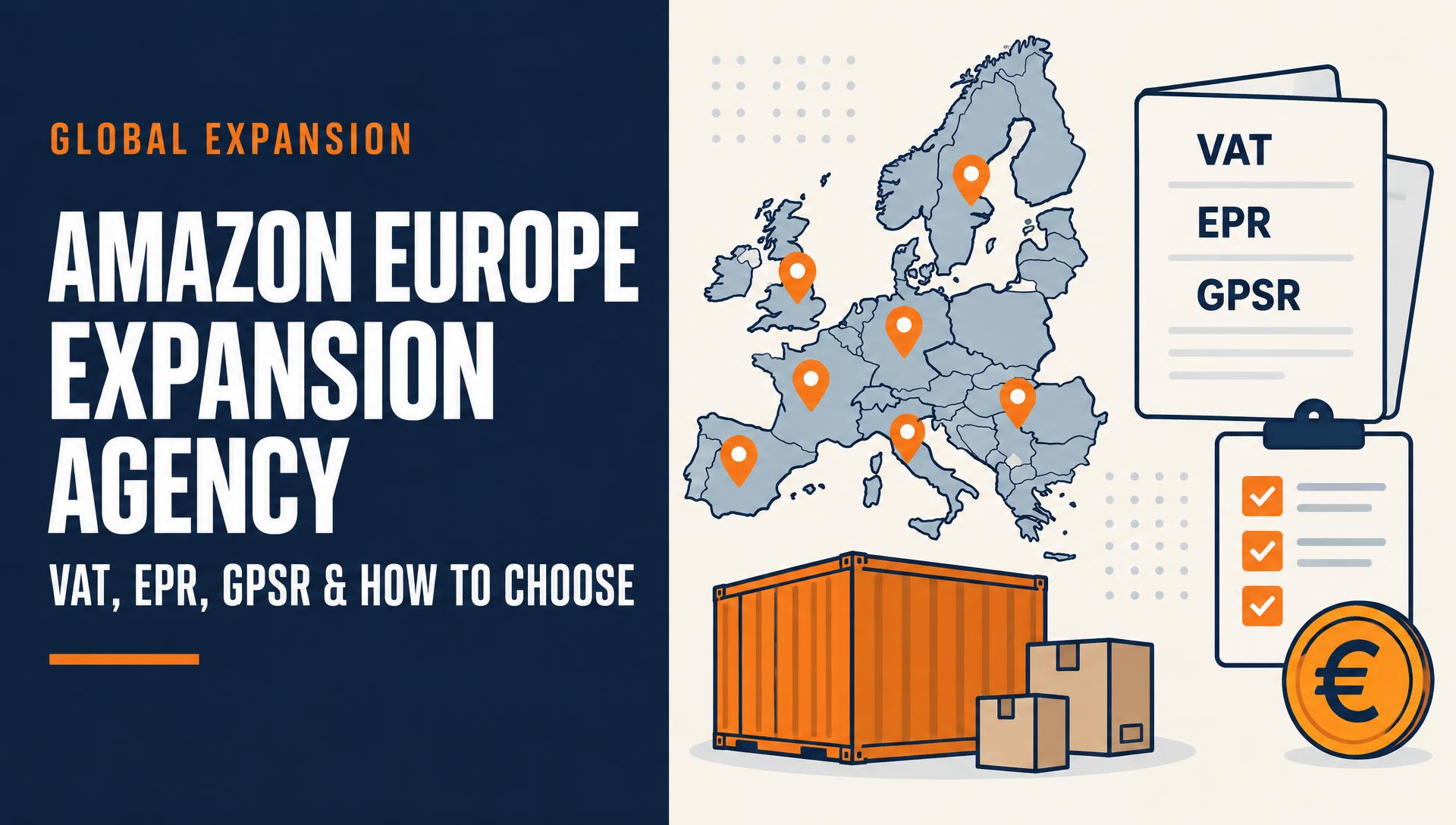
Compliance is where most European launches slow down, and 2026 added two new items: packaging EPR under the EU's new regulation and the €3 duty on low-value parcels. An agency should be able to show you, for each country, which of these apply to your products and who will handle them.
| Requirement | What it means | Key date |
|---|---|---|
| VAT registration | Register for VAT in each country where your stock is stored; use the EU One-Stop Shop for cross-border sales to consumers | Before the first sale from stock in that country |
| Packaging EPR (PPWR) | Register as a producer of packaging and report volumes; Amazon may stop non-compliant products, and Pan-EU sellers must comply in Germany, France, Italy, Spain and the Netherlands | August 12, 2026 |
| GPSR | Name an EU Responsible Person; show manufacturer and Responsible Person contact details, product identifiers and safety information in the local language on listings and labels | In force since December 13, 2024 |
| Other EPR | Electrical and electronic equipment, batteries and other categories have their own producer registrations in many countries | Before listing affected products |
| €3 customs duty | Flat €3 per item category on parcels up to €150 shipped to EU consumers from outside the EU | July 1, 2026 until July 1, 2028 |
| EU handling fee | An additional €2 handling fee on distance-sale parcels, as reported by Amazon MCF | Expected late 2026 |
3. How the €3 EU duty changes the business case
From July 1, 2026, the EU applies a temporary €3 customs duty to each item category in a low-value parcel (up to €150) imported from outside the EU. The European Commission's example: five T-shirts in one parcel pay €3, because they share one tariff classification, while three T-shirts and a watch pay €6. The flat fee applies until July 1, 2028, after which normal customs duties apply by product type.
This mainly affects brands that ship orders to EU customers directly from the US, UK or Asia. Inventory imported in bulk into an EU fulfillment center is cleared through customs as a normal import instead. For many brands, the duty is one more reason to hold stock inside the EU rather than shipping parcel by parcel, but run the numbers per product: storage, VAT registration and EPR costs come with that choice.
4. Choosing a fulfilment model: EFN, Pan-EU or single-country FBA
The UK is separate from the EU for customs, VAT and product safety rules, so it needs its own stock plan. Northern Ireland is covered by GPSR.
| Model | How it works | Best for |
|---|---|---|
| European Fulfillment Network (EFN) | Stock in one country, usually Germany; Amazon ships to customers in other stores for a cross-border fee | Testing demand in several countries with one stock location |
| Pan-European FBA | Amazon distributes stock across countries to be closer to shoppers | Proven products ready for faster delivery across Europe, with VAT and EPR in each storage country |
| Single-country FBA | Stock and sales focused on one store | Brands starting in one priority market, often Germany or the UK |
5. Localisation is a keyword job, not a translation job
Machine-translated listings miss how shoppers actually search. German shoppers may use compound nouns, French shoppers different product names, and the most searched term for a product in Spain may not be a translation of the English term at all. A good agency researches keywords natively in each market, then writes titles, bullets, A+ Content and backend search terms around them.
Alexa for Shopping now answers shopping questions in Germany, France, Italy and the UK, among other countries, so listings also need specific, accurate details it can draw on in the local language.
6. Advertising across European marketplaces
Each European store needs its own campaigns, keywords, budgets and reporting currency. Copying US campaigns rarely works: costs per click, competition and conversion rates differ by country, and some marketplaces report in different currencies. Start with branded and exact-match campaigns on proven local keywords, then expand.
7. How to choose an Amazon Europe expansion agency
- Ask for a written, country-by-country plan with an order of launch, stock plan and budget, not just a list of services.
- Ask which compliance tasks the agency does itself and which go to tax advisers, EPR compliance schemes or Responsible Person providers, and who is accountable if something is missed.
- Ask who writes the German, French, Italian and Spanish listings, and whether they are native speakers with keyword data.
- Ask for examples of European marketplace results, with the market and time frame stated.
- Ask how reporting works across currencies and countries.
- Check the contract: notice period, who owns the accounts and data, and what happens to compliance registrations if you leave.
8. Red flags
- Promises of guaranteed sales or rankings in a new country.
- Plans to launch in every European store at once without testing demand.
- Vague answers about VAT, EPR or GPSR, or 'we will sort it after launch'.
- Machine-translated listings with no local keyword research.
- No clear owner for compliance renewals and reporting deadlines.