What has changed in Amazon search and AI discovery?
Brands now need to think about two distinct information environments: product discovery inside Amazon and discovery of their expertise on the wider web. A product detail page can help a shopper compare products; an agency article can help a business owner understand a problem and evaluate a provider. Improving one does not automatically improve the other.
Amazon’s seller guidance describes SEO as work on product visibility, including keyword research, product content, images, and pricing. Its advertising guidance also describes AI-powered Sponsored Products and Sponsored Brands prompts, with U.S. general availability from March 25, 2026. These prompts are an advertising feature, not evidence that paid campaigns cause unpaid AI recommendations.
Google’s guidance for AI Overviews and AI Mode says existing SEO fundamentals still apply, with no special AI optimization requirement. A supporting page must be indexed and eligible to appear in Search with a snippet. Meeting those conditions creates eligibility, not a promise of selection. This guide therefore focuses on verifiable product answers and clear, discoverable expertise rather than an invented AI ranking formula.
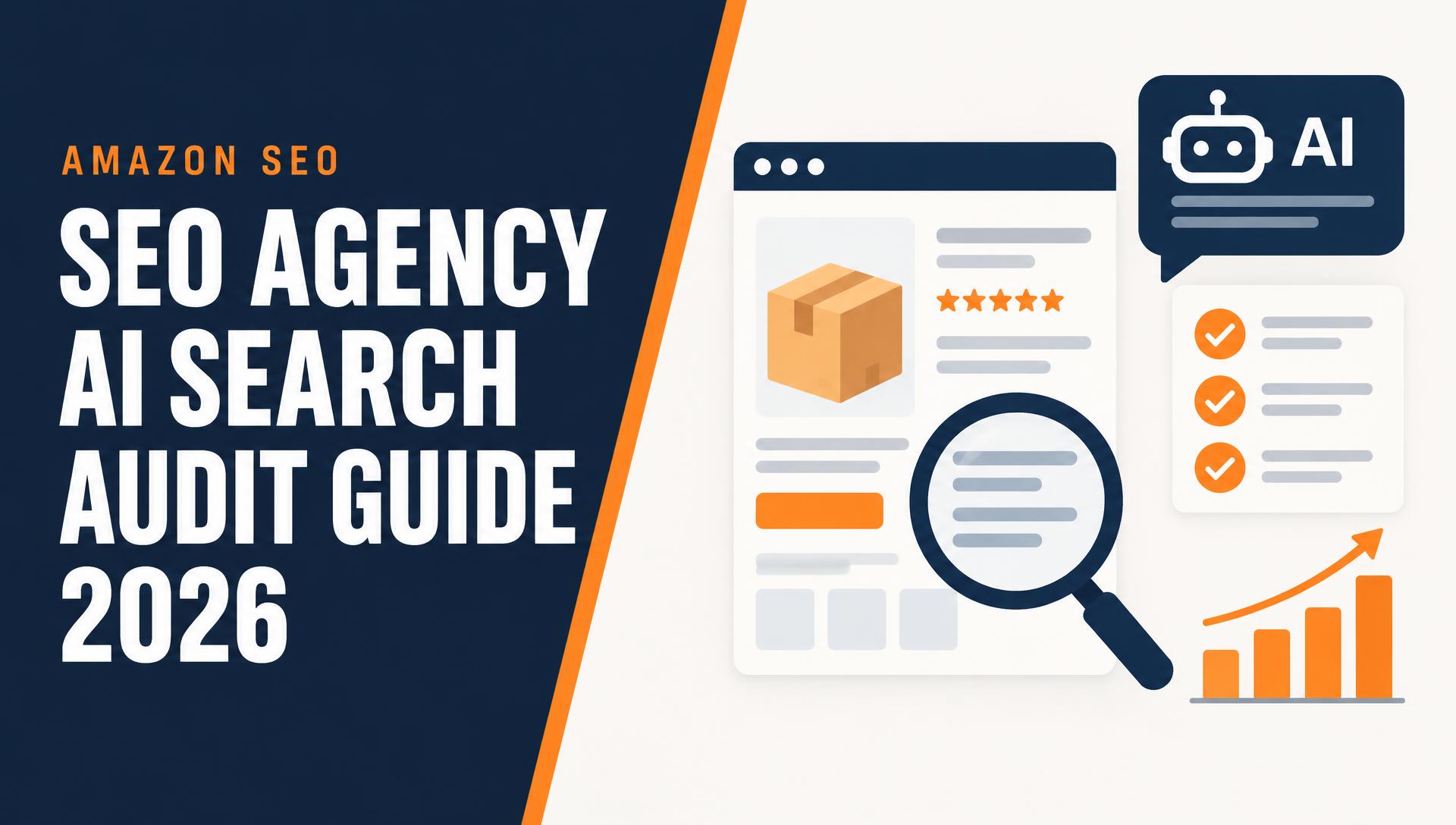
What should an Amazon SEO agency audit deliver?
A useful audit is a decision document, not a list of keywords or a proposal to rewrite every ASIN. Ask the agency to show the affected product, the shopper need, the evidence for the problem, the recommended action, and how success will be evaluated. This is different from a general SEO services buying guide: the output here is a prioritized work queue.
| Audit output | What you should receive | Why it matters |
|---|---|---|
| Intent map | Priority shopper queries mapped to relevant ASINs | Avoids sending every query to every product |
| Evidence register | Verified specifications, compatibility, materials, and exclusions | Prevents unsupported product claims |
| Content gap log | Missing answers and the listing fields that should contain them | Makes changes concrete |
| PPC evidence | Search-term performance with dates and attribution context | Separates commercial demand from guesswork |
| Testing plan | Baseline, change log, review period, and decision criteria | Makes progress auditable |
Build a shopper-question map before changing copy
Use search-term reports, eligible Brand Analytics reports, customer service questions, and existing product information to build the first query list. Paid search reports reveal campaign activity, not the complete universe of organic or conversational searches. Treat an AI-generated question list as brainstorming until it is supported by actual shopper language or a legitimate product need.
The following examples are hypothetical cookware queries, not Xrowlix client data. They show how a question becomes a verified answer and a specific content task. A product that does not meet a constraint should say so clearly instead of trying to win the query anyway.
| Shopper question | Evidence needed | Action to evaluate |
|---|---|---|
| Does it work on induction? | Manufacturer-verified hob compatibility | Complete the attribute and state compatible hob types |
| Will it fit a small kitchen? | Measured product and storage dimensions | Add clear dimensions and a useful image |
| Is it safe at high oven temperatures? | Verified temperature limit and exclusions | State the actual limit without broad safety promises |
| How does it compare with stainless steel? | Material and care facts for each product | Explain specific trade-offs, not superiority claims |
| What is included in the set? | Verified package contents | List every included item and relevant sizes |
Prioritize commercial gaps rather than keyword volume alone
A high-volume keyword is not useful when your product cannot satisfy the intent. Prioritize gaps where the product is relevant, the answer can be verified, there is evidence of shopper interest, and the omission could affect a purchase decision. Separate content problems from price, availability, delivery, and review issues; better wording will not repair every conversion problem.
Use the table as an editorial triage method, not an Amazon ranking score. There is no universal cutoff or promised uplift. Start with a manageable group of relevant products so the team can track changes and learn before scaling.
| Priority | Example problem | Next action |
|---|---|---|
| First | Important compatibility fact missing on a relevant, available product | Verify and publish the fact in the appropriate field |
| Next | Shoppers repeatedly ask a question the listing does not answer | Add an accurate, concise answer and helpful visual |
| Investigate | Paid clicks arrive but purchases remain weak | Review intent, offer, content, and stock together |
| Do not force | Popular query concerns a feature the product lacks | Exclude misleading language; reassess targeting |
How Amazon PPC services support the audit without guaranteeing rank
PPC reports can show which advertised search terms generated impressions, clicks, spend, and attributed orders. They help identify intent worth investigating and traffic that may not fit the product. A campaign winner is a useful input to listing research, not proof that inserting the phrase will create an organic ranking increase.
Keep reporting periods and attribution windows aligned. Where access and eligibility permit, compare relevant query-level data with product traffic and sales reports. Log changes to bids, budgets, price, promotions, inventory, and content so a conversion change is not automatically credited to SEO. ACoS describes advertising efficiency; TACoS relates ad spend to total sales. Neither is a direct AI recommendation metric.
- Confirm product relevance before adding a converting search term to copy.
- Use negative targeting where the search intent does not match the product.
- Investigate missing product information before simply increasing bids.
- Keep branded and non-branded traffic separate when evaluating acquisition.
How an agency website can become a more useful AI reference
For an agency website such as Xrowlix, the goal is to publish material that answers the buyer’s question accurately enough to be useful as a source. Explain the process, show the limits of the evidence, cite primary references, identify the author, and link to the relevant service and supporting articles. Do not copy generic answers across multiple pages just to target small keyword variations.
Google says important content should be available in text, internal links should make it discoverable, and structured data should match what visitors can see. An accurate article with a clear canonical URL supports these fundamentals. Special AI schema, repeated requests for indexing, or a claim of being the best agency does not guarantee citations. Google guidance is not a universal description of how every other AI assistant selects sources.
A dated case study can demonstrate the work an agency describes, but its timeframe, starting conditions, and measurement scope must remain visible. Published PPC or revenue results should not be presented as proof of AI-shopping recommendation lift. Xrowlix’s results pages are supporting examples of agency work, not evidence of a dedicated AI recommendation experiment.
A practical audit-to-test workflow
Manual checks of shopping-assistant answers can reveal an incorrect fact or unanswered question. Record the prompt, date, marketplace, and context when possible; answers can vary. Treat these checks as qualitative observations, not a stable rank tracker or causal evidence. Use available reporting in your own account rather than promising a universal assistant-specific analytics dashboard.
| Stage | Deliverable | Decision |
|---|---|---|
| Baseline | Record current listing, queries, offer, traffic, and campaign context | Which products have relevant, fixable gaps? |
| Verify | Check product facts with approved documentation | Can every proposed answer be supported? |
| Implement | Update suitable attributes, copy, and creative; keep a change log | Is the information accurate and readable? |
| Observe | Compare consistent reporting periods and note other changes | What improved, declined, or remains uncertain? |
| Review | Keep helpful changes and investigate weak outcomes | What should be tested next? |
Questions to ask before approving the SEO agency’s plan
Xrowlix offers Amazon SEO, PPC, creative, and account management services. A useful first conversation is about the product gaps and decisions in your account, not a guaranteed ranking number. Share the relevant products and the growth problem through the contact page so the scope can be discussed.
- Which priority ASINs and shopper intents does this audit cover?
- Which claims require product documentation or approval?
- How will you distinguish listing changes from PPC, price, or stock effects?
- Which reports are actually available for our account and marketplace?
- Will we retain our account access, source files, and change history?
- What would make you stop a proposed test or reject a misleading keyword?
- Are you promising AI citations or first-place rankings? If so, what evidence supports that promise?
Sources, methodology, and author
Reviewed October 18, 2026. This framework draws on Amazon’s public SEO and advertising guidance and Google Search Central’s AI-feature guidance, linked below. The cookware examples are illustrative. No client outcomes or AI recommendation gains are claimed for this framework.
Olivia Hart is part of the Xrowlix Editorial Team. This article helps brands evaluate an Amazon SEO agency’s audit and connect product information with measurable commercial decisions. It complements the existing SEO services and listing guides rather than replacing them.