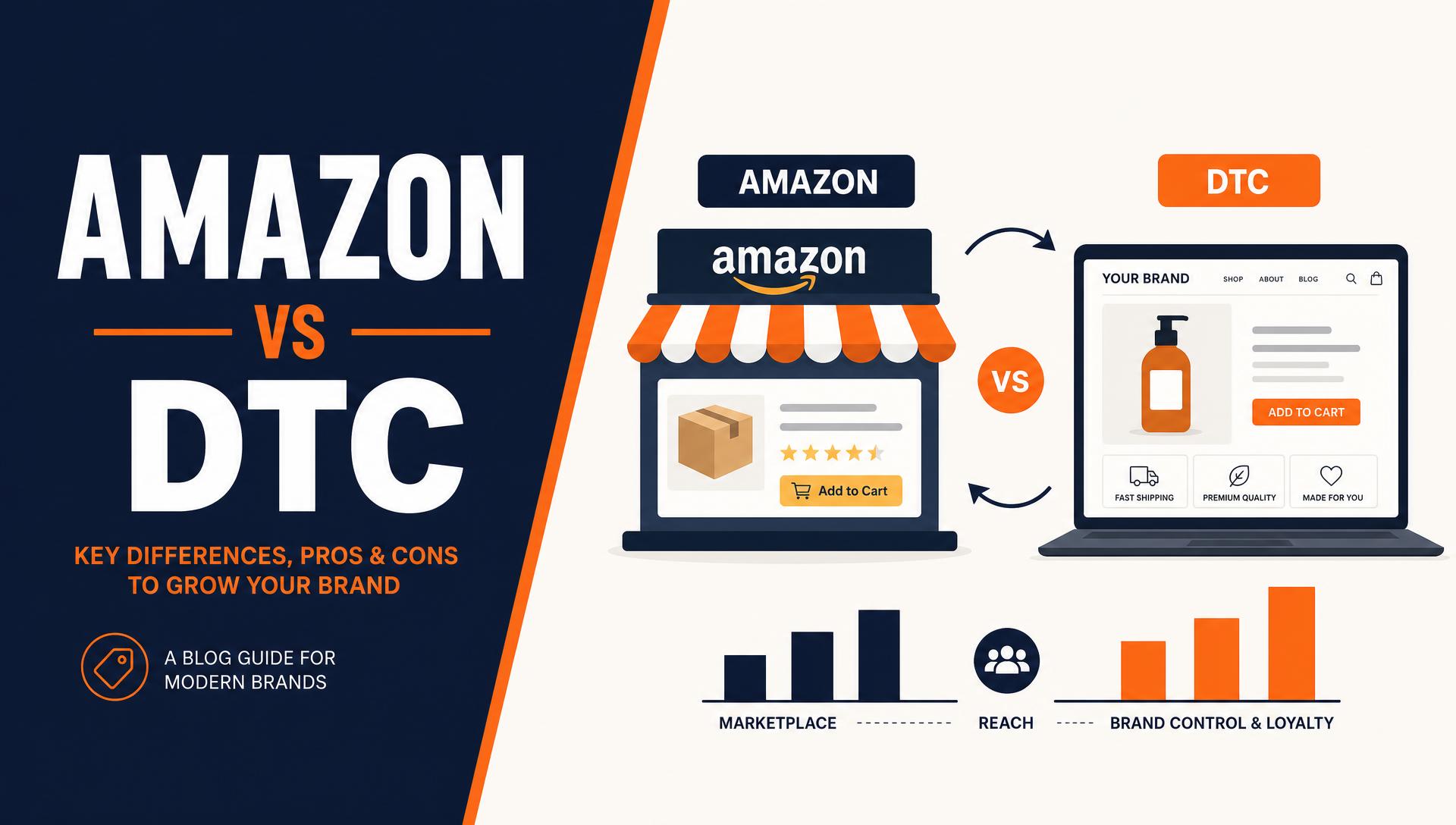
What does 'Amazon DTC' actually mean?
Amazon DTC describes a brand that sells directly to consumers on Amazon as a first-party seller of its own products, rather than through distributors or wholesalers, while also running its own website. You control pricing, listing content, advertising, and customer experience on both surfaces.
The strategic question is no longer whether to be on Amazon. It is how much of your growth budget each channel deserves, and which one carries which job in the funnel.
Amazon versus DTC: the honest comparison
Neither column wins outright. Amazon gives you speed and volume; DTC gives you margin and memory. A brand that ignores Amazon leaves easy revenue on the table, and a brand that lives only on Amazon rents its entire customer base.
| Factor | Amazon | DTC website |
|---|---|---|
| Demand | Built-in high-intent traffic | You buy every visitor |
| Cost of sale | Referral, FBA, and ad fees of 35 to 50 percent | Payments, shipping, and paid media of 25 to 45 percent |
| Customer data | Limited, aggregated only | Full email, phone, and purchase history |
| Time to first revenue | Weeks | Months |
| Repeat purchase control | Subscribe and Save only | Email, SMS, subscriptions, loyalty |
| Brand control | Constrained by Amazon templates | Total |
A budget split model that works
Use repeat-purchase rate as the switch. If fewer than 20 percent of buyers reorder within 90 days, your product does not yet justify heavy DTC retention spend, so weight the budget toward marketplace volume.
- Under 5 million dollars in revenue with low repeat rate: roughly 70 percent Amazon, 30 percent DTC
- Strong repeat rate above 30 percent: move toward a 50 / 50 split and fund email, SMS, and subscription
- Consumable or refillable products: bias DTC earlier, because lifetime value pays back the higher acquisition cost
- Considered, one-time purchases: stay Amazon-weighted and use DTC for brand storytelling and reviews
Does Amazon cannibalise DTC sales?
Some overlap is real, but in most catalogues Amazon captures shoppers who were never going to buy from your site. They search on Amazon by default, trust Prime delivery, and do not want a new checkout account.
The useful move is not to withhold products from Amazon. It is to differentiate the offer: bundles, multi-packs, and marketplace-specific variants on Amazon, and subscriptions, personalisation, and full-range access on your own store.
Turning both channels into one flywheel
- Use Amazon reviews and rating volume as social proof in DTC ads and on product pages
- Insert package inserts that invite Amazon buyers to register for warranty on your site, which is compliant and builds an email list
- Feed Amazon Search Query Performance keyword data into your DTC SEO and Google Ads
- Run Amazon DSP retargeting against your own site visitors so paid DTC traffic converts somewhere