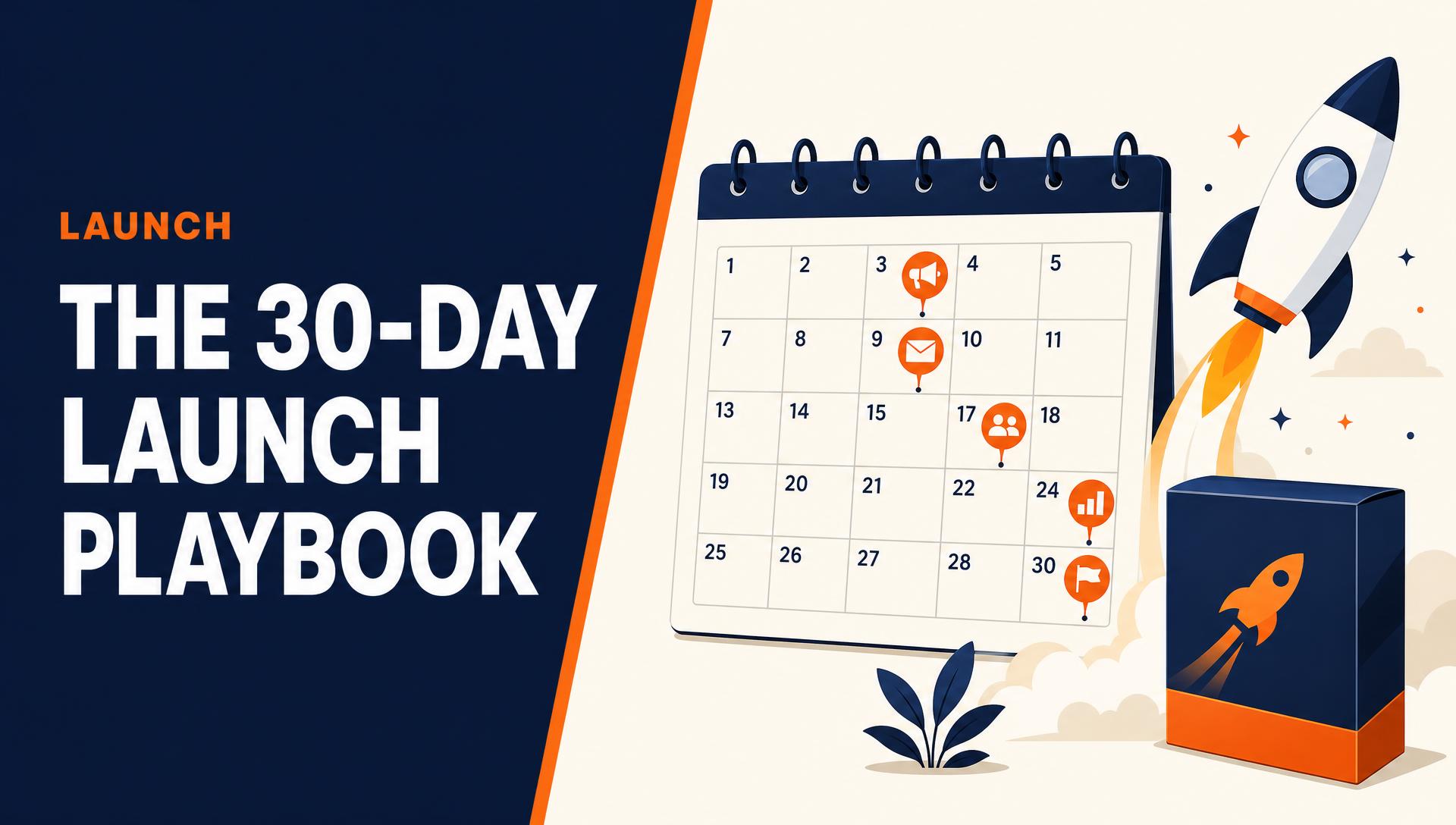
Why the First 30 Days Decide Everything
A brand new ASIN has no history. Amazon's search algorithm does not know what it is, which searches it belongs in, or whether shoppers respond when it appears. Every click, purchase, and review in the first month teaches the system those three things, and it teaches them fastest while the listing is still inside its honeymoon window, roughly the first 30 to 45 days, when Amazon gives new listings a temporary visibility boost to test how well they convert.
That window is the entire reason this playbook is sequenced the way it is. Miss it and the SKU has to earn rank the slow, expensive way against listings that already have reviews and conversion history. Use it well and the product can reach page one on its priority keywords before most competitors even notice a new listing launched.
Before Day 1: The Pre-Launch Foundation
Everything in the 30-day clock builds on what is ready before the clock starts. We do not open a single campaign until three things are true.
The listing is finished. Title, bullet points, A+ Content, main and secondary images, and backend search terms are all live and built around 15 to 25 target keywords we have already pulled search volume for. A weak listing burns significantly more ad spend once traffic starts, so this gets solved before launch, not during it.
Inventory is confirmed in FBA. Launching before stock is actually checked in and available kills momentum immediately, since an out-of-stock listing drops out of search regardless of how well it was ranking.
Vine is enrolled. For Brand Registered SKUs, we enroll in Amazon Vine the moment inventory checks in, before the listing even goes live for public sale, by setting the Offer Start Date a few weeks out. This lets the first 20 to 30 reviews land before day one of paid traffic, which changes the entire economics of early PPC. If the SKU is a multi-variation listing, Vine now needs to be planned per functional variation rather than one variation covering the whole family.
Days 1 to 7: Open Traffic and Start the Review Clock
Launch day opens three Sponsored Products campaigns at once: an Auto campaign to surface search terms we have not thought of, an Exact Match campaign on our priority keywords from the research phase, and a Product Targeting campaign against relevant competitor ASINs.
Bids start aggressive, often 1.5 to 2 times Amazon's suggested bid. In week one, we are buying sales velocity and impression share, not efficiency. ACoS in this phase can reasonably run 60 to 100 percent. That is expected and it is not a sign anything is wrong. Trying to run an efficient campaign against a listing with no conversion history almost always means losing the impression share that actually builds rank.
The Request a Review button gets triggered for every order between day 5 and day 30 after delivery, the only fully compliant way to prompt organic reviews outside of Vine. We never touch incentivized reviews, review swaps, or seeded purchases. Amazon's detection for manipulated reviews has gotten sharp enough that the risk to the whole account is not worth it.
Days 8 to 14: The First Optimization Cycle
Seven days of PPC data is the minimum needed to make real decisions, so the first optimization cycle happens here, not sooner. We pull the search term report from the Auto campaign and start separating signal from noise.
Terms with conversions get promoted into the Exact Match campaign. Terms burning clicks with no conversions get added as negatives so spend stops leaking into search queries that were never going to buy. Bids on keywords with a clearly high or clearly low conversion rate get adjusted individually rather than moving the whole campaign at once.
This is also when Vine reviews typically start landing, usually within two to four weeks of enrollment. Watching the review count alongside conversion rate at this stage tells us whether the listing itself needs work, since a conversion rate sitting below 8 percent once reviews are on the page usually points to images, pricing, or copy rather than traffic quality.
Days 15 to 21: Shift Budget to What Is Working
By the third week, enough data exists to separate the keywords worth funding from the ones that were only ever going to be tested. Budget shifts toward the Exact Match terms with proven conversion rates, and daily budgets on underperforming campaigns get trimmed rather than paused outright, since a full pause resets the learning Amazon's algorithm has already built.
Bids start coming down from their aggressive week-one levels on any keyword with enough order volume to trust the data. This is the point where the campaign starts transitioning from a pure velocity engine toward something closer to a sustainable, ongoing structure.
Days 22 to 30: Consolidate and Set the Baseline
The final week of the launch window is about consolidation, not new experiments. Organic rank on the priority keywords gets checked against where it stood on day one. Ad spend gets tightened toward a realistic target ACoS for month two, typically in the 25 to 35 percent range depending on category and margin, down from the 60 to 100 percent the launch phase justified.
Everything measured in these final days, the keywords holding organic position, the ACoS the account can sustain, the review count and rating, becomes the baseline the SKU scales from starting day 31. A clean day-30 baseline is what makes month two a scaling conversation instead of a rebuilding one.
30-Day Milestone Targets
These are directional targets we use to judge whether a launch is on track, not universal thresholds. Category, price point, and competitiveness shift the exact numbers.
| Milestone | Target |
|---|---|
| Listing fully optimized and live before traffic | Day 0 |
| Vine reviews landing | Day 7 to 14 |
| First PPC optimization cycle complete | Day 7 |
| Units sold | 50+ by day 14 |
| Conversion rate once reviews are live | 10 to 15 percent |
| Page-one organic rank on priority keywords | 3 or more by day 30 |
| ACoS trending down toward sustainable range | By day 21 to 30 |
Mistakes That Quietly Kill a Launch
- Running PPC efficiently from day one. A launch judged on ACoS instead of velocity underspends its way out of the honeymoon window before the algorithm can rank it.
- Launching before inventory is confirmed live in FBA. An out-of-stock listing loses organic position immediately, and it does not come back just because stock does.
- Skipping Vine or relying only on the Request a Review button. Organic review requests convert at roughly 5 to 10 percent of orders, too slow to build a review base inside 30 days.
- Pausing underperforming campaigns instead of trimming them, which resets learning and costs more in momentum than it saves in spend.
- Treating day 30 as the finish line rather than a baseline. Months two and three decide whether the SKU becomes a real earner.
The Launch Sequence at a Glance
- Day 0, Listing, keywords, inventory and Vine ready
- Days 1 to 7, Auto + Exact + Product Targeting live, aggressive bids
- Days 8 to 14, Search term harvest, negatives, first Vine reviews
- Days 15 to 21, Budget shifts to proven converters, bids ease down
- Days 22 to 30, Rank check, ACoS tightened, baseline locked