What actually happens at day 45
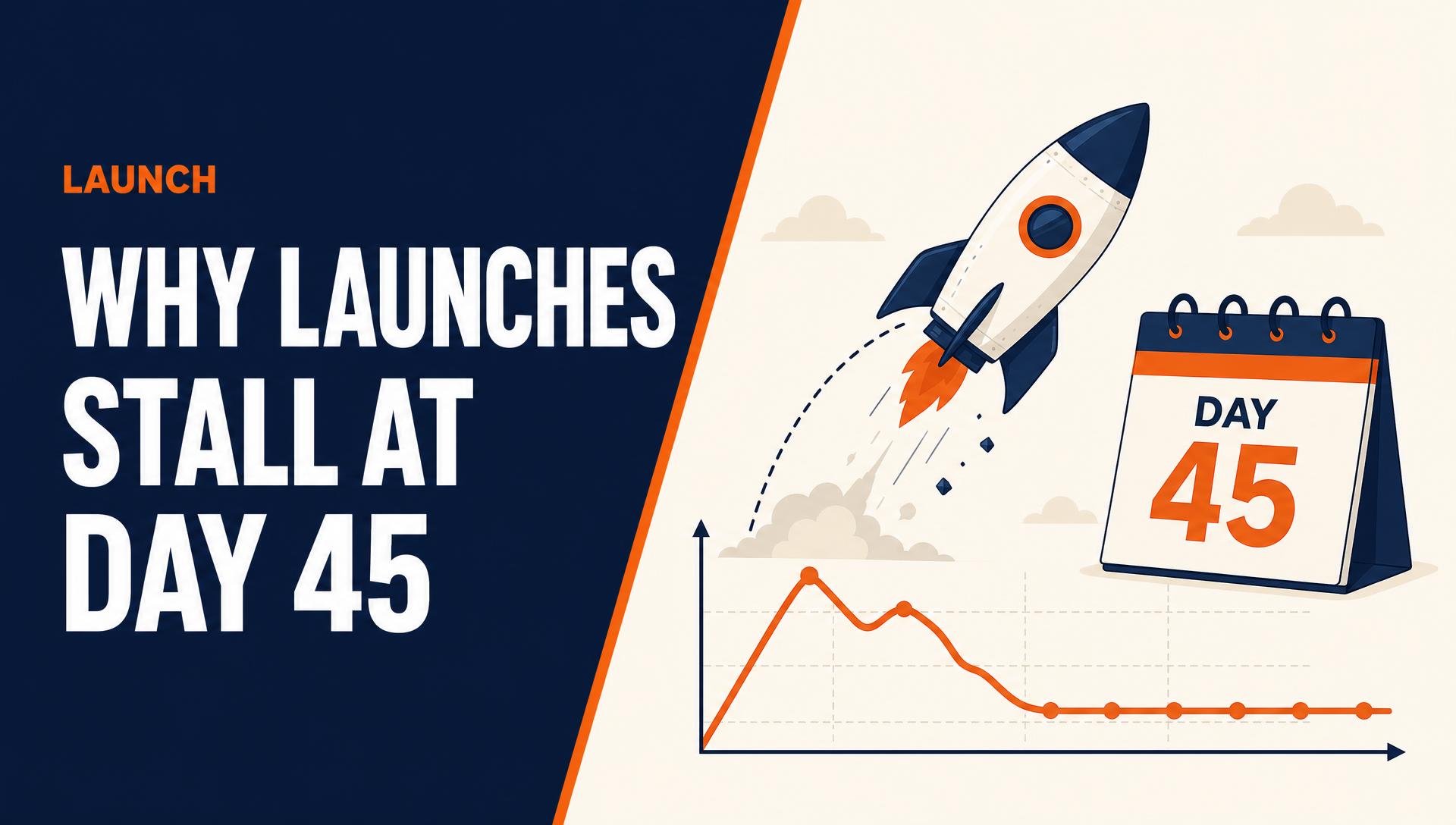
Nothing changes instantly on day 45 itself. What changes is the weighting behind how Amazon evaluates the listing. During the honeymoon window, generally the first 30 to 45 days, the algorithm leans on short-term signals: immediate conversion rate, click-through rate, and keyword relevance, because there is no sales history to lean on yet. Once that window closes, evaluation shifts toward accumulated sales history and the review base the product has actually built, the same standard every established competitor is judged against.
A listing that spent its first 30 to 45 days building genuine conversion data and a real review base barely notices the transition. A listing propped up by aggressive discounting or inflated PPC bids, without the product-market fit to back it up, hits the switch to standard evaluation and drops, often sharply, right when sellers expect momentum instead.
The cold start reality behind the honeymoon period
Amazon has never officially confirmed the exact mechanics of the honeymoon period, but its cold start patents point to something more specific than a temporary visibility gift. A new listing has no six-month sales average to plug into the ranking calculation, so early on that missing history functions closer to a null value than a penalty, which is where the appearance of a boost comes from.
The practical implication matters more than the mechanism. Amazon is using this window to test whether a listing deserves the organic position it is temporarily holding. Every session, click, and purchase in the first 30 to 45 days is training data the algorithm uses to decide whether the product earned that shelf space permanently.
The three root causes of a day-45 stall
Cause 1: bids got pulled back before organic rank could hold on its own. The most common trigger. Sellers see a launch converting well under aggressive week-one bidding, get nervous about ACoS, and cut spend right as the honeymoon window closes rather than after organic rank has demonstrably taken over the visibility PPC was providing. Cutting spend before that handoff drops total visibility at the exact moment the algorithm is deciding whether the listing earned a lasting position.
Cause 2: review count never reached the level the conversion rate depended on. Honeymoon conversion rates are often inflated by the temporary boost itself, novelty, and early Vine reviews. If the review base stalls below the 15 to 30 range most categories need, the listing's true unassisted conversion rate is lower than what the algorithm measured, and that gap surfaces the moment standard evaluation kicks in.
Cause 3: the underlying conversion rate never actually proved itself. Steep launch discounting can generate real velocity without proving the listing converts at a sustainable price. Once pricing normalizes or ad-subsidized traffic drops, the true conversion rate is meaningfully lower than what looked strong during the discounted window.
The day 30 to 45 transition checklist
Bids and budgets should come down gradually across this window as each check clears, not all at once on a fixed day-30 or day-45 deadline. A listing that has not cleared review count or true conversion rate yet needs ad support to continue a little longer, even at a higher ACoS than originally planned.
| Check | What to verify before cutting spend |
|---|---|
| Organic rank | Priority keywords holding page one without PPC impression share propping them up |
| Review count | At least 15 to 30 reviews live, in line with category norms |
| True conversion rate | Holding steady at or near full price, not just during a launch discount |
| Inventory position | Stock sufficient to avoid a stockout as organic momentum builds |
| ACoS trend | Trending down over two to three weeks, not a single-day snapshot |
How to recover a launch that already stalled
A missed honeymoon window cannot be undone by improving the listing after the fact. Once Amazon's evaluation has settled the product into a lower-rank position, recovery usually requires a deliberate relaunch that sends a fresh, coordinated set of positive signals rather than a slow accumulation of small tweaks.
The first step is an honest diagnosis. Pull Business Reports and keyword-level data to identify which of the three root causes applies. A rank-driven stall, where visibility dropped but conversion is healthy, calls for a different fix than a conversion-driven stall, where traffic still arrives but does not convert. Treating both the same way, usually by increasing ad spend across the board, wastes budget without addressing the actual failure.
Once the cause is clear, a structured relaunch, meaning a deliberate reset of pricing, creative, or keyword targeting depending on the diagnosis, paired with a fresh disciplined PPC push, rebuilds the sales velocity and review signals needed to earn organic position back. That works meaningfully better than nursing a stalled listing with incremental tweaks over several more months.