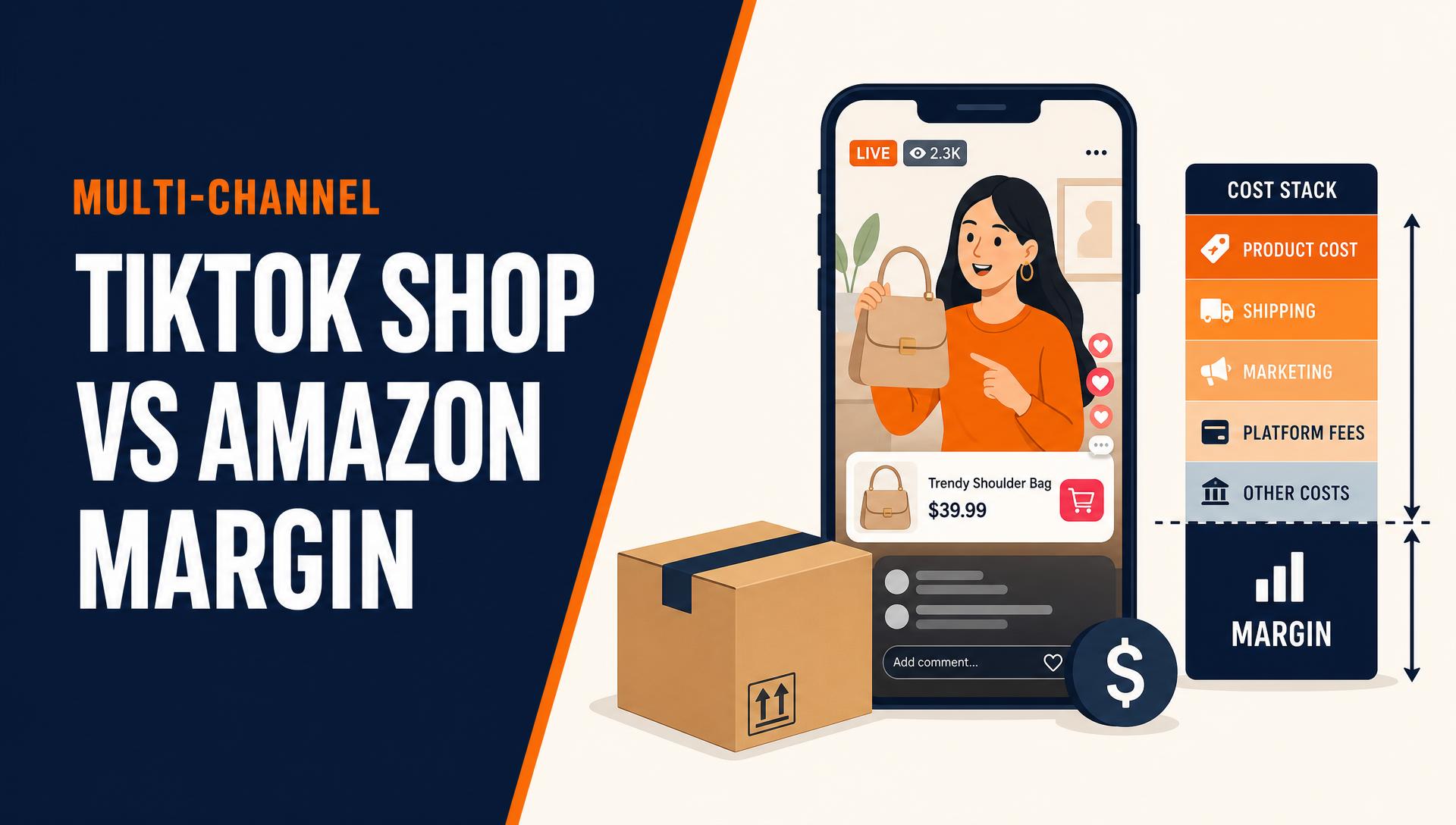
Why Amazon Sellers Are Adding TikTok Shop in 2026
TikTok Shop is the fastest-growing marketplace in recent history, with U.S. GMV projected around 23 billion dollars in 2026 and organic reach most sellers have not seen on Amazon since its earliest years. The two platforms also serve fundamentally different buying behavior. Amazon is a search channel: a shopper already knows what they want and types it in. TikTok Shop is a discovery channel: a shopper did not know they wanted a product until a creator showed it to them mid-scroll.
That difference is exactly why most established brands run both rather than choosing one. TikTok Shop creates demand, Amazon captures the buyer who already knows the brand. The mistake is assuming that because the platforms complement each other strategically, they will also behave the same way financially. They do not, and the P&L problems almost always start there.
The Real Cost Stack, Not Just the Headline Fee
TikTok Shop's flat 6 percent U.S. referral fee genuinely is lower than Amazon's category-dependent 8 to 15 percent. Sellers who stop reading there consistently underprice their launch. The full stack looks different once fulfillment and creator commissions are added.
| Cost Layer | Amazon | TikTok Shop |
|---|---|---|
| Platform referral fee | 8 to 15 percent by category | Flat 6 percent (5 percent on select jewelry) |
| Fulfillment | FBA, roughly $3 to $8+ per unit | FBT, roughly $2.86 to $4.28+ per unit, now required for most categories |
| Storage | $0.78 to $2.40 per cubic foot monthly | Varies, generally lower volume tiers in 2026 |
| Paid acquisition | PPC, typically 10 to 25 percent of revenue | Video shopping ads, typically lower CPM, plus optional Smart Promotion fee |
| Performance-based cost | None distinct from ads | Creator commissions, typically 10 to 30 percent by category |
| Typical all-in cost of sale | Roughly 30 to 45 percent of retail price | Roughly 25 to 45 percent of retail price |
Fulfilled by TikTok Is Now Mandatory, Here's What Changes
As of March 31, 2026, Fulfilled by TikTok became the required shipping method for U.S. sellers in most categories, ending the earlier option to fulfill independently through a 3PL for many product types. FBT fees run roughly $2.86 to $4.28 or more per unit depending on size and weight, comparable to FBA in most cases.
Some sellers use Amazon's Multi-Channel Fulfillment to ship TikTok Shop orders out of existing FBA inventory instead, which simplifies operations at the cost of an additional $1 to $2 per unit. Whether that trade makes sense depends entirely on order volume and how much warehouse complexity the business can absorb, so it is worth modeling both before committing inventory to one fulfillment path.
Creator Commissions: The Line Item That Breaks Most Models
This is the cost Amazon sellers most consistently underestimate, because Amazon has no direct equivalent. Creator commissions function as a variable cost of acquisition, not a marketing expense in the traditional sense, and TikTok Shop's algorithm rewards products that creators are actively promoting far more than it rewards a brand account posting on its own.
| Category | Typical Creator Commission |
|---|---|
| Beauty | 15 to 30 percent |
| Home | 12 to 18 percent |
| Fashion | 10 to 15 percent |
| Tech | 5 to 10 percent |
| Open collaboration marketplace, general | 5 to 15 percent |
Build the Margin Model Before You Launch, Not After
Before listing a single product on TikTok Shop, run the full stack against your actual landed cost: referral fee, FBT fulfillment, the creator commission rate you intend to offer, and any ad spend layered on top through Smart Promotion or video shopping ads. If the resulting margin does not clear a sustainable floor at your planned retail price, the price needs to move before launch, not after the first batch of creator content is already live.
This is also where product selection matters more than most sellers expect. A SKU with strong Amazon margin because it carries no creator commission on that channel can turn marginal once a competitive 20 percent commission is added on TikTok Shop. Products with room to absorb that commission are the ones worth prioritizing for a TikTok Shop launch first.
Inventory and Fulfillment: One Pool or Two
Sellers generally choose between three setups: a fully separate inventory pool fulfilled through FBT, a shared pool fulfilled through Amazon's Multi-Channel Fulfillment, or a hybrid split by SKU based on volume. High-velocity SKUs with predictable TikTok Shop demand usually justify a dedicated FBT pool once volume supports it. Lower-volume or newly launched SKUs often make more sense through MCF while demand is still being validated.
The decision should be revisited quarterly, not set once and left alone. As TikTok Shop volume grows on a given SKU, the fulfillment math that favored MCF at launch often flips in favor of a dedicated FBT pool.
Pricing Across Two Platforms Without Undercutting Either
Running the same retail price on both platforms is usually the safest starting point, since a visible price gap between Amazon and TikTok Shop invites comparison shopping that neither channel benefits from. The margin difference between platforms should be absorbed in the cost stack, not passed to the shopper as a price difference.
Where pricing flexibility helps most is in bundling. Bundles built specifically for TikTok Shop, priced to comfortably absorb the creator commission while still landing at an attractive per-unit price in a creator's video, often outperform a straight single-SKU listing carried over unchanged from Amazon.
A Phased Rollout That Protects Amazon Cash Flow
The sellers who avoid a P&L shock treat the TikTok Shop launch as funded by existing Amazon cash flow, not by capital pulled away from Amazon operations before the new channel is generating its own revenue.
Pre-recorded creator videos drive roughly two-thirds of U.S. TikTok Shop sales, with livestreams still under 30 percent of GMV, which means the early rollout budget is generally better spent on short-form video seeding than on livestream investment.
- Phase 1, Product seeding to a small creator group for organic UGC and first reviews
- Phase 2, Open affiliate marketplace listing at a commission the margin model supports
- Phase 3, Layer Smart Promotion and video shopping ads on proven SKUs
- Phase 4, Move high-velocity SKUs into a dedicated FBT inventory pool
Mistakes That Blow Up the P&L
- Pricing to match Amazon margin without accounting for creator commission, almost always discovered after inventory and creator relationships are already committed.
- Treating FBT as optional. Independent fulfillment ended for most U.S. categories on March 31, 2026.
- Diverting Amazon working capital to fund a TikTok Shop launch before the new channel is cash-flow positive.
- Ignoring settlement timing. Standard sellers can see payout delays of around 15 days, longer for flagged accounts, which needs to be modeled into cash flow planning.